Pandemic Preparedness Strategies to Consider for your Assisted Living Facility
The emergence and re-emergence of infectious diseases has become one of the greatest threats to the health of Americans and people worldwide. Now more than ever, it is vital for our healthcare facilities to have a proactive plan in place in the event of another outbreak.
To do our part in preparing for future public health emergencies, EZhealthcarejobs.com has put together this guide to help health care facilities stay ahead of the next crisis. The strategies discussed in this article are tailored for assisted living facilities, however these tips can be adapted for nursing homes, health centers, and other medical facilities.
Before we get started, it’s important to identify what constitutes a pandemic.
According to the Center for Disease Control (CDC), a disease or condition is not a pandemic merely because it is widespread or kills a large number of people. The disease must also be infectious and spread over several countries or continents. Pandemic preparedness differs from standard healthcare risk management in that pandemics are riddled with uncertainty. So here are
Pandemic Preparedness Strategy #1 Developing an Incident Command Team
First, identifying an incident command team is a top recommendation. During a pandemic, this team can meet regularly to discuss changes that may arise throughout your facility’s response.
Individuals to consider including in your pandemic command team:
· CEO/President
· Administrator/ Executive Director
· Chief Financial Officer
· Maintenance Director
· Infection Preventionist
· Director of Marketing
· Wellness Care Coordinator or Director of Nursing
· Director of Human Resources
· Admissions Coordinator
· Social Services Director
· All Stakeholders
Note: Some assisted living communities are smaller than others so your incident command team may look a bit different from the list above. This is okay, as long as all responsibilities are delegated.
Pandemic Preparedness Strategy #2 Delegating Major Tasks Ahead of a Crisis
As Morgan Katz, Assistant Professor of Infectious Disease at John Hopkins University circa 2020, advised, “Delegating tasks is of paramount importance here. One person is not capable of managing the [pandemic] response for your community and ensuring that roles are clear before an outbreak is an absolute must.”
Major Tasks to Consider Delegating:
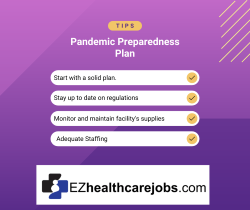
1. Staying up-to-date on local, state and federal regulations
The person responsible for this task should be given time to look up any new guidance at the beginning of each day. We recommend that this member of staff attend any webinars offered by the health department or CMS. This responsibility includes having contacts within your local health department so your facility can ask questions and clarify any issues with changes in regulations. Changes in regulations may include how to report positive cases or who to test and how often to test in healthcare facilities.
“All of these can change on a daily basis during a pandemic, making it important to have someone looking at this regularly.”
2. Monitoring and maintaining your facility's supply of PPE
In the early months of the COVID-19 pandemic, many assisted living facilities found it difficult to acquire the necessary amount of PPE in a timely fashion. Because of this, Morgan Katz suggested that assisted living facilities “plan to have a minimum of three months' supply [of PPE] and identify several different suppliers in the case of shortage or delays in deliveries.” The person responsible for your facility’s PPE supply should be aware of contacts for the local and state health department to request emergency supplies. Katz also warned assisted living facilities against waiting “until you are in crisis capacity before notifying the health department, as it can take up to a week or more to receive these supplies.”
3. Obtaining access to testing and creating policies and procedures to perform any necessary testing
4. Staffing
Throughout the pandemic, we’ve also learned more about how important adequate staffing is in nursing homes and assisted living communities to reduce the size of outbreaks. The member of staff you select to be responsible for staffing should also be responsible for updating and reviewing staff return-to-work forms based on symptoms and positive tests This person should also ensure that your facility has access to backup staff and a clear contingency plan.
5. Infection prevention
The individual placed in charge of this role is responsible for training staff and residents in proper hand hygiene and safe distancing practices. This person should also expect to take responsibility over training staff on proper environmental cleaning practices and the proper way to don, doff, and dispose of PPE.
6. Communication
In an interview, Leslie Hardesty (the co-founder of Esther's Place, a group of four assisted living communities in Maryland ranging from insides from 12 to 40 beds) indicated that “communication is the biggest part,” of responding to a global health emergency. In a separate interview with Juliana Bilowich, Gus Keach-Longo (the president and CEO of The Towers in New Haven) described his strategy for communicating with residents, staff, and resident families during the COVID-19 pandemic saying, “I wrote a memo just about every week and a half now, where in the beginning, it was every three or four days explaining everything that was going on... In addition to the memo that I send out pretty regularly, we also have two Zoom calls a week with all of our team... I've had several people say to me that the memos that we put together and send out all the time, often times had information that residents haven't heard before. Then eventually they would end up hearing about it in the news. They started to really trust us.”
Pandemic Preparedness Strategy #3 Identifying and Preparing Space for Positive or Exposed Residents
After your command team has been selected and tasks have been appropriately dispatched, consider walking through your facility and preparing an environment for positive cases, for those that need to be isolated, as well as for individuals that may need to undergo observation.
Steps to Identifying and Preparing Physical Space for Positive or Exposed Residents:
1- Determine a desired location to place positive residents and those under observation
These areas ideally should be spaces where residents can have their own private room and bathroom. We recommend that this area is created so it can be accessed through a separate entry so people accessing this region will not have to walk through the rest of the community.
2- Designate areas where staff have space to don and doff their PPE
3- Prepare separate staff quarters including break rooms, charting rooms, and a restaurant for staff working with infected residents.
4- Identify equipment designated for positive residence
This equipment should be appropriately labeled and not leave that part of the community.
5- Update Advanced Directives
All of your residents should have the opportunity to review and update their advanced directives on a regular basis anyway, but this is even more important in the context of a pandemic. If possible, someone should reach out to palliative care teams to discuss the known risks associated with the outbreak. It’s equally important to make sure that residents understand and can convey their wishes for the future (I.e., whether they want to remain in the community, consent to incubation, or wish to be transferred to the hospital etc). Having this information in a spreadsheet, prepared and available during an outbreak can drastically shift the effectiveness of your facility’s response.
6- Communicate
We cannot emphasize the importance of this step enough. Confusion can be avoided by providing a clear, truthful picture of your facility’s plans prior to an outbreak. Should a case be identified, family members and residents should be given information regarding plans for cohorting positive residents, how testing is being performed in the community, the facility’s plans for safe visitation, and procedures for hospital transfer.
Pandemic Preparedness Strategy #4 Collaborate with Health Departments and Other Agencies
Josh Sharfstein, the vice dean for Public Health Practice and Community Engagement at the Johns Hopkins Bloomberg School of Public Health, urged assisted living facilities not to forget their critical partnerships with state and local health agencies charged with protecting public health in a pandemic. Despite the stress of keeping up with the surge and tides of a pandemic, Sharfstein emphasized that “you are not alone,”
Benefits of Collaboration:
· Reliable support
Having established connections with your health department and other health care agencies can give your facility a place to turn to when new or difficult situations arise.
· A tête-à-tête on what guidance is important
Having an agreed upon list of recommendations to follow during a crisis from your local Health Department can help eliminate confusion and hysteria.
· Assistance addressing hard questions
There may come a time when your facility tries to put policies in place that some people may not understand. Bringing in a health official to explain the science and reasoning behind your policies can be a great way to help your residents and staff feel comfortable with the changes. Health officials may also be able to answer some of the harder questions thrown your way by staff, residents, and resident family members.
Pandemic Preparedness Strategy #5 Review Infection Prevention Strategies with Staff
Another great way to stay ahead of a public health emergency in a health care facility is to review the basic strategies for infection prevention such as the proper way to don and doff PPE, proper PPE disposal, mask policies, and the procedure for communicating with residents or patients.
The 3 Ps of Infection Prevention Control:
Policies
· The general framework to guide an organization’s decisions and actions.
· Policies are generally broad statements that set expectations for our community
· Policies describe the who, what and when
Procedures
· Step by step descriptions of actions to be taken to complete a task
· Procedures define the process for meeting expectations set in policies
· Procedures describe the who, what, when, and how
Practice
· The implementation of the set procedure
Pandemic Preparedness Strategy #6 Reviewing Past Pandemics and Outbreaks
The COVID-19 pandemic has exposed the lack of systems in place to enable assisted living facilities to respond effectively and efficiently to a pandemic. But even before the COVID-19 pandemic, there were issues with maintaining consistent and reliable infection prevention practices in the long-term care setting. These communities are expected to operate with the infection prevention practices of a hospital, even though the population and physical setup often does not allow for this to be done effectively.
· Physical Distance Challenges
The communities at assisted living facilities are generally composed of older adults who have comorbidities that put them at risk for more severe diseases. These residents often require hands-on care, which means close personal contact with another individual. This increases the potential opportunities for exposure due to this inability to maintain a safe distance.
Along with exposure to the staff, any people in this ALC setting participating in group activities and/or group dining have more exposure to others than residents living in a single-family home. This type of setting makes physical distancing a challenge, particularly in memory care or dementia units, when residents are not able to understand the need to physically separate.
· The Atmosphere at Assisted Living Facilities
In general, the design for assisted living communities is set up for group living. This may include shared living quarters with roommates, and often includes group activity rooms in order to promote shared experiences and interaction. In addition, assisted living communities are designed to resemble a home. Because of this desire to maintain a comfortable, home-like environment for residents, these communities often struggled to use infection prevention methods that are helpful and necessary in the acute care setting. During the pandemic, assisted living facilities reported
· Difficulties Enforcing Proper Safety Precautions
During the COVID-19 pandemic, many assisted living facilities reported that they struggled to require consistent and proper mask use for residents with cognitive disabilities who struggled to understand the need for such practices. There were also challenges with requiring consistent mask use, particularly when residents were moving around what they saw as their home.
· Poor Infection Prevention Education
Hand hygiene had been noted to be a challenge in observations of care in long term care facilities as well. This was often due to lack of infection prevention education and lack of access to sinks or hand sanitizer.
Pandemic Preparedness Strategy #7 Create Plans for Internal and External Communication
· Communication with Residents
It's just as critical to talk with residents and tenants as it is to update staff throughout a pandemic. As the co-founder of Esther’s Place, Leslie Hardesty, repeated in her interview with an Assistant Professor of Infectious Disease at John Hopkins University, “Fear is a big factor [for residents], especially when you're elderly and you recognize that the disease that could strike you, could potentially kill you.” One of the best ways to alleviate fear and develop trust within your facility during a crisis is constant, transparent communication with residents.
· Strategies for Communication with Stakeholders and Media
Stakeholders can refer to lots of different people in different categories including municipal leaders, family members, care partners, and/or anyone else in the community who may want to hear about how things are going in your assisted living and senior housing organizations. To stay up-to-date on the community needs during an emergency health crisis, consider contacting local, regional, or state assisted living or senior housing advocacy organizations.
· Communication with Staff and Staff Education
Staff play a crucial role in the prevention of and response to public health emergencies. As we got to see this first hand during the COVID-19 pandemic, inadequate or absent training can become a major barrier to effectiveness of your facility's emergency response.
According to Molly Nice, an infectious disease epidemiologist at the Pennsylvania Department of Health, here are some things that your assisted living facility should consider when educating staff on the facility’s expectations for following infection prevention and pandemic protocols.
- The Age of your Audience
- The Ethnic or Cultural Background of your Audience
- The Preferred Language of your Audience Members
Your educational materials may need to be available in a variety of languages, “especially if the content uses complex jargon or specific details” Molly Nice (an infectious disease epidemiologist at the Pennsylvania Department of Health) explained.
- The Learning Preferences of your Audience
Not only should you consider how your staff best identifies and absorbs information, but you should identify the resources that are available to your organization’s community.
- The Most Effective Setting for Providing this Education
Some practices (like sound procedures) can be discussed or demonstrated in a classroom, meeting room or online, while other demonstrations may need to occur at the point of care.
Pandemic Preparedness Strategy #8 Reflect on Other Staffing Considerations
If the Pandemic has taught us nothing else, it has brought to light how over-worked, exhausted and burnt-out healthcare workers can become on the front lines of a global health crisis. Every health care facility should dedicate a portion of their Crisis Preparedness Plan to staff. Yes, training staff during a crisis is important, but so is supporting their mental health and well-being. One way our facilities can accomplish this is by pre-emptively discussing the possibility of staff shortages and identifying contingency plans to mitigate this. Hosting consistent meetings to discuss staffing assignments and strategies that can reduce exposure within the community is another way to maintain effective and healthy staff during a health crisis.
Though the last few years of the COVID-19 pandemic have been tough, this time has given us an opportunity to prepare better for what may lie ahead. As you embark upon this journey, don’t forget to thank yourself and your staff for the hard work and dedication that has been given. There is great work ahead of us, but in these uncertain times, creating or updating your ALF’s Pandemic Preparedness Plan can reassure your staff, residents, and their families, that their safety and well-being is your top priority. The thorough work you choose to do now will save thousands of lives later.
Welcome to your hero’s journey.
#NALW, #NationalAssistedLivingWeek, #AssistedLivingFacilities, #ALF, #AssistedLiving, #InfectionPrevention, #IPC, #PandemicPreparedness, #COVID19, #MonkeyPox, #EmergencyManagement, #WellbeingPromotion
Sources:
· “Staff & Resident Activities for National Assisted Living Week.” S&SBlog. https://www.ssww.com/blog/staff-resident-activities-for-national-assisted-living-week/
· “Strategies for Assisted Living Communities during COVID-19" Coursera. Sep, 2022.
· Loveday H, Wilson J. Pandemic preparedness and the role of infection prevention and control - how do we learn? J Infect Prev. 2021 Mar;22(2):55-57.
· MacPhail T. (2010) A predictable unpredictability. The 2009 H1N1 pandemic and the concept of ‘strategic uncertainty’ within global public health. Behemoth 3: 57–77.